
No Resting Place
To lament, to wail
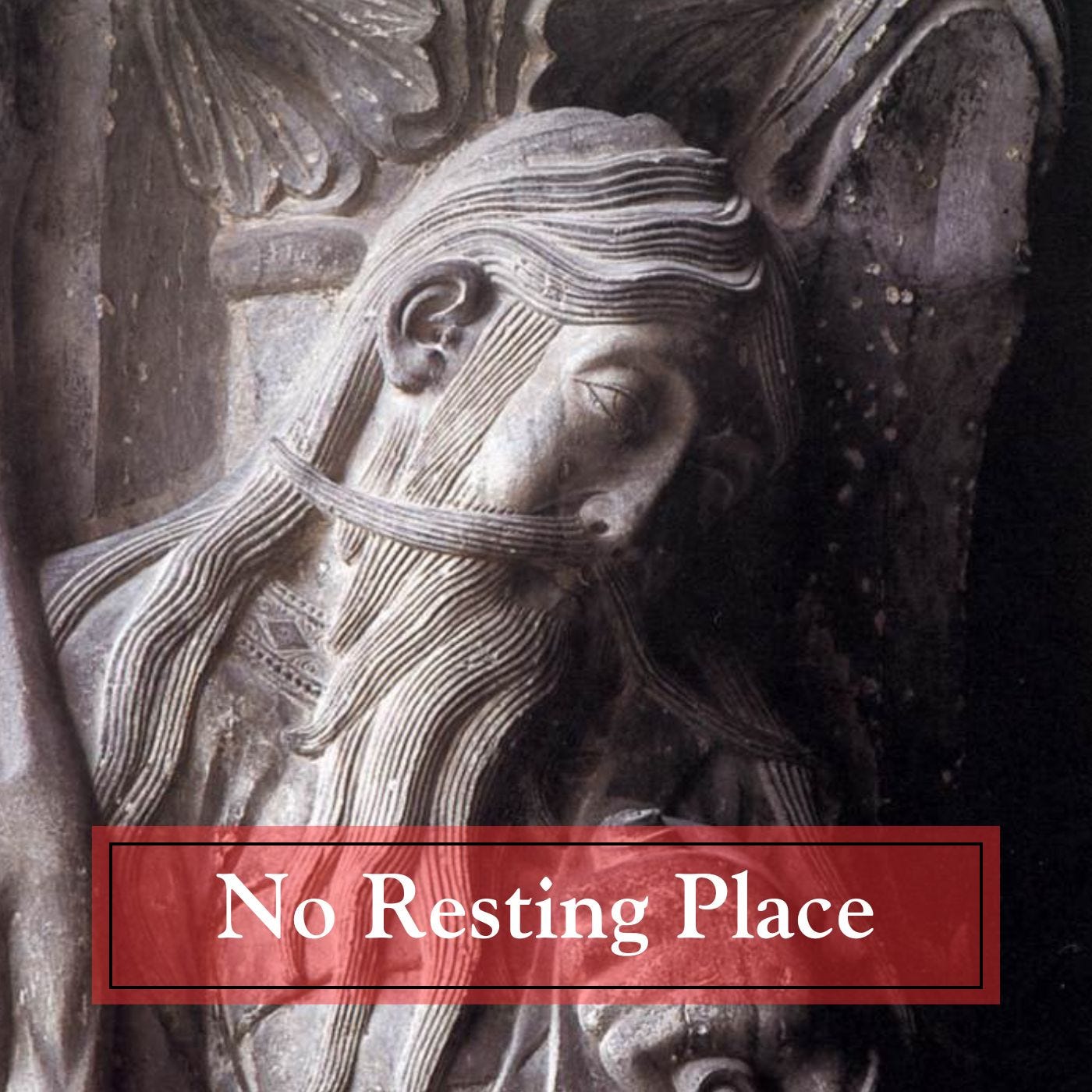
I think many of my composer colleagues will agree: every piece you write is in some way special, and bears with it various back-stories and technical concerns. Sometimes, maybe only once every three or four years, a piece is such a challenge that the result is not just a good piece, but a piece which represents a sort of milestone in your development. I don’t mean to sound grand here; everybody has significant birthdays or successful cataract operations. However, this piece felt like one of those for me, where I finally, after 30+ years of writing music, solved the problem of negotiating a technical and emotional concern with the same music — something I’ve been wrestling with for most of my adult life.


When Peter asked me to write a set of lamentations for The Tallis Scholars, as a continuation, perhaps, of Recordare, Domine, I had been reading endless articles about the Windrush scandal. At that time, the stories and fates of so-called “Dreamers” (technically and offensively considered “illegal” immigrants to the United States, who came as children) were frequently in the news, and I found countless resonances with the Windrush generation of Caribbean migrants to the UK who found themselves in various ways stateless, detained, and denied benefits. I found myself automatically connecting these interviews with the texts of the lamentations themselves, and decided to incorporate modern English interviews inside the traditional organisation of settings of the lamentations. Obviously, those are not my stories to tell, but I realized that I could energetically point towards those stories from within my own comfort-zone of biblical texts expressed through polyphony.
The structure is traditional, with long, melismatic settings of the Hebrew letters which announce each verse. The fact that the Hebrew letters are set to music is a gift to composers; I would wager that more people could sing along with the letters in the Couperin setting (Jod and He in particular) than they could the verses themselves. With the exception of Migravit Judas, the verses are meditative, with imitative counterpoint occasionally complicating their simplicity. Between each verse, the interviews are presented almost as recitative, but then one word or phrase is restated and taken up by a variation on the preceding Hebrew letter; for instance, the word “grey,” (from the sentence “Just these diaries saying the word grey”) is set with the exact same descending scale as the letter beth. I’ve written about that here.
The accusatory “what are you doing here” loudly reprises aleph, and ghimel, with slightly grotesque glissandi smearing each chord change, is flipped upside down over the text “To lose your job, have your driving licence revoked and lose your right to housing is to systematically lose your identity.” That sentiment echoes the Lamentations: “she dwells now among the nations, but finds no resting place.”
Daleth, set to a long, cyclical exploration of a single chord, and the attendant lamentation’s dire, lonely “all her gates are desolate,” finds a rhyme in the fragment “there’s been a loss, a great loss.”
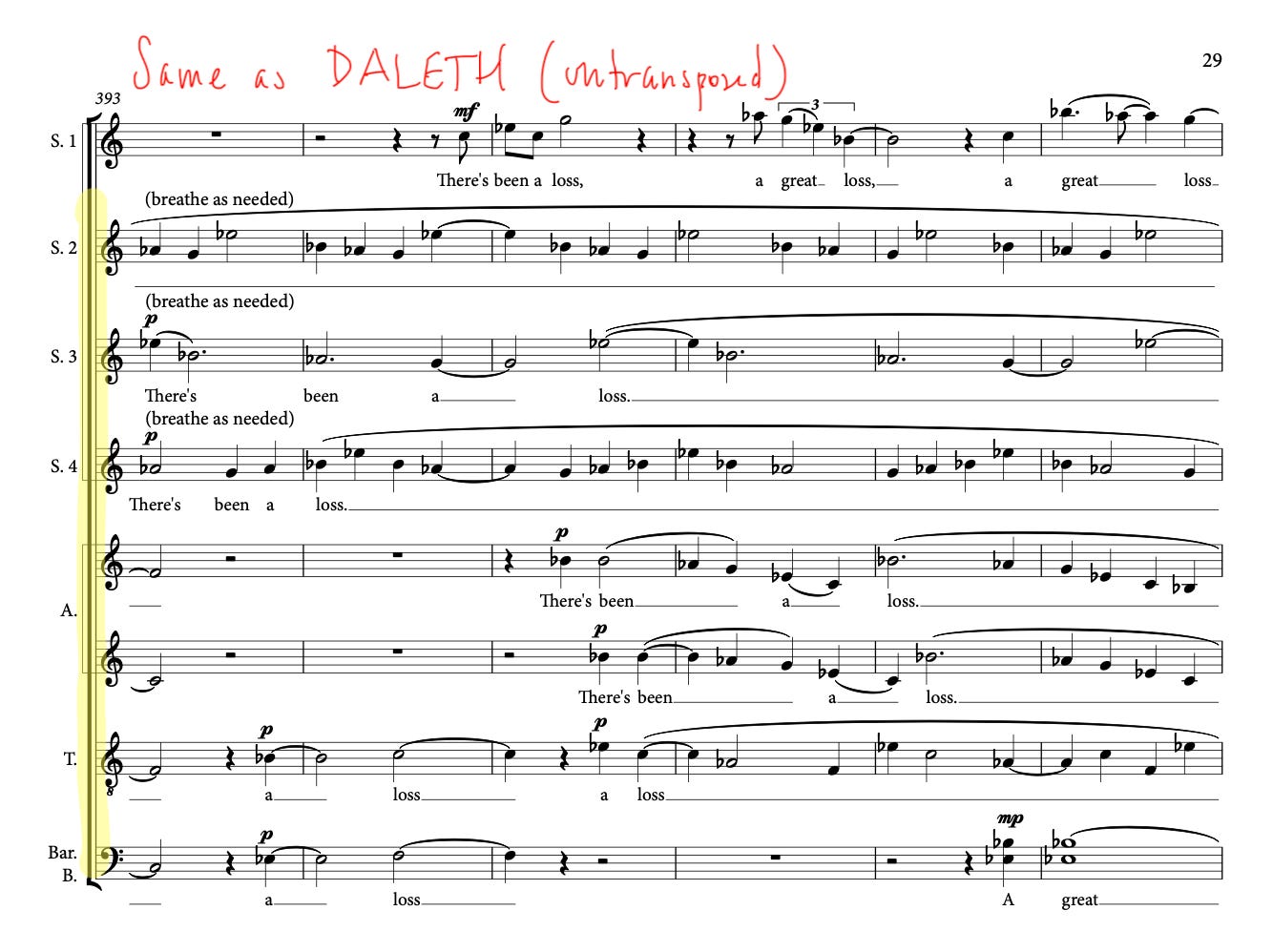
He, set to a violently radiant C major chord, precedes a duet for the altos (“her children have gone away, captives before the foe”), setting up the most prolonged interlude, written by the Venerable Dr Rosemarie Mallett, who, after referencing the slave port at Gorée Island, Senegal, writes, “To remember our history is to lament, to wail.” I set “…to wail” to the same music as the letter he, but here, it is floating and quiet and seamlessly morphs into the Lamentations’ refrain (Ierusalem, Ierusalem, convertere ad Dominum Deum tuum). A reprise of the beth/“grey” music continues this sentiment, and we rewind fully to the music of aleph/“What are you doing here” before a quiet coda.
For me, this juxtaposition of texts summarises the fundamental discomfort and mourning we all confront when reading the Lamentations, and when we read, in the newspaper and in histories both written and oral, about the violent displacement of human beings and confront our own implication and complicity in the same.
The score is available here, and the recording is here.
Listening to your wonderful pieces at this very moment. Love the colors and textures—wow